
Educating federal
lawmakers and intercity rail stakeholders on California’s growing passenger rail system

MISSION
California's Intercity Rail Corridors Linking Everyone (CIRCLE) was established by the state's passenger rail agencies to inform federal policymakers about Amtrak's state-supported services and promote California’s expanding rail system and investments. With the nation's top intercity passenger rail networks, the Pacific Surfliner, Capitol Corridor, and Gold Runner routes collectively served over 5 million passengers in FY 2019. California has invested over $3.2 billion in its rail network over the past 40 years, connecting major cities and providing access to 122 additional destinations through bus services. The system is managed by the Capitol Corridor Joint Powers Authority (CCJPA), the Los Angeles – San Diego – San Luis Obispo (LOSSAN) Rail Corridor Agency, and the San Joaquin Joint Powers Authority (SJJPA), and funded by the California State Transportation Agency (CalSTA).
MEMBERS

The Capitol Corridor Joint Powers Authority (CCJPA) was created in 1998. The CCJPA governing board consists of two representatives from the eight service counties – Placer, Sacramento, Yolo, Solano, Contra Costa, San Francisco, Alameda and Santa Clara – and representatives from local planning and transit agencies in the region. Bay Area Rapid Transit (BART) provides administrative services support to the CCJPA.
The Los Angeles – San Diego – San Luis Obispo (LOSSAN) Rail Corridor Agency is a joint powers authority formed in 1989 that is composed of rail owners, operators and planning agencies along the entire LOSSAN rail corridor. The Agency is governed by a Board of Directors composed of 11 voting members, as well as four non-voting, ex-officio members. In addition to working to improve passenger rail ridership, revenue, on- time performance, operational flexibility, and safety, the LOSSAN Agency assumed management responsibility for the Pacific Surfliner service in July 2015, following the execution of an interagency transfer agreement with the state of California.


The San Joaquin Joint Powers Authority (SJJPA) was created in 2012 to protect and improve existing rail corridor service. The SJJPAS governing board consist of 10 member agencies and local governments: Alameda County, Contra Costa Transportation Authority , Fresno Council of Governments, Kings County Association of Governments, Madera County Transportation Commission, Merced County Association of Governments, Sacramento Regional Transit, San Joaquin Regional Rail Commission, Stanislaus Council of Governments, Tulare County Association of Governments. Administrative and management support is provided by the San Joaquin Regional Rail Commission (SJRRC).
1 out of 5
Amtrak riders boarded a train in CA in 2019
5.6 Million
Passengers carried on just three rail routes in CA in 2019
$7.6 Billion
Invested by CA in improving its intercity rail network
ROUTES
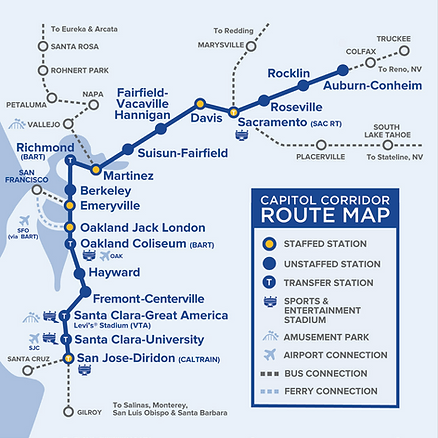

The 170-mile Capitol Corridor route, managed by CCJPA, provides service between San Jose, Oakland, Sacramento, and Auburn, with 30 trains on weekdays and 22 on weekends. The Capitol Corridor provides accessible multi-modal connection points to Bay Area Rapid Transit (BART), Sacramento Regional Transit (Sac RT), and Santa Clara Valley Transportation Agency (VTA), and other local transit providers. In Fiscal Year (FY) 2025, the Capitol Corridor carried over 1.13 million passengers and ranked as the third busiest intercity rail corridor in the United States.

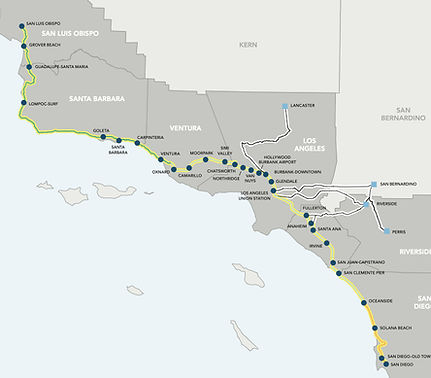
Pacific Surfliner, managed by LOSSAN, travels along a 351-mile coastal rail route through San Diego, Orange, Los Angeles, Ventura, Santa Barbara and San Luis Obispo counties, serving 29 stations. It is the busiest state-supported Amtrak route and the second busiest intercity rail corridor in the United States.
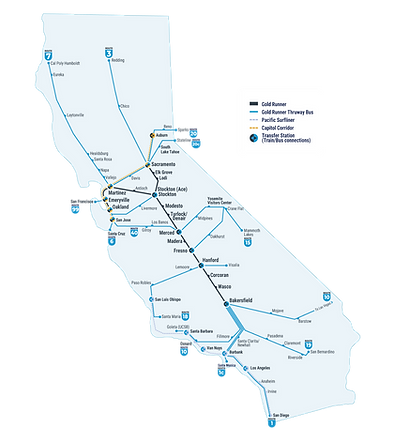

Gold Runner, managed by SJJPA, provides service between Bakersfield, Fresno, Stockton, Oakland, and Sacramento. The service provides vital transportation for historically underserved Central Valley communities, with more than 70% of riders identifying as non-white and/or Hispanic. It offers connections to ACE, and an extensive thruway bus network reaching Los Angeles, Las Vegas, and other destinations. Riders primarily use the service for family visits and leisure travel. In FY 24/25, Gold Runner carried over 900,000 passengers, making it one of the busiest intercity rail corridors in the nation.

ADVOCACY
-
Maintaining State Routes as Innovation Centers
In 2008, the Passenger Rail Investment and Improvement Act (PRIIA) shifted funding responsibility from the federal government to the states for intercity passenger routes under 750 miles. As the primary funders of core intercity rail corridor service operated by Amtrak, states have been granted flexibility to provide responsive ridership experiences for their unique corridor passengers. In California, this includes featuring local craft food and beverage products on the Pacific Surfliner, independent route marketing services provided by the JPAs, and state-owned equipment on the Capitol Corridor and the San Joaquins. In order to continue to provide modern ridership experiences passengers demand, states must continue to be allowed to be responsive to their riders.
-
Accountability and Transparency in PRIIA Sec. 209 state-Amtrak payments
IPRIIA required Amtrak to develop and implement a cost methodology to fairly share costs between states and Amtrak to financially support state-supported routes. Unfortunately, despite the above goals, numerous government watchdog reports have found Amtrak’s cost accounting to be opaque, even as it shifts more costs to states and localities. The Infrastructure Investment and Jobs Act (IIJA) contains important state-Amtrak payment reforms including a comprehensive cost model update. We support transparency and accountability in state-Amtrak cost sharing payments.
-
Maintaining California’s National Leadership in Intercity Rail Planning and Development
As the primary funders of state-supported routes, states have maintained the lead role in intercity passenger rail planning and development. PRIIA required states to develop an FRA-accepted state rail plan with periodic updates and encouraged close coordination between FRA and states in rail policy, planning, and development. California has invested over $3.2 billion in improving its intercity passenger rail network over recent decades and has a bold vision for the future. We need to esure that California maintains its ability to plan and deliver premier passenger railroad services directly with FRA.
-
Support Robust Funding of USDOT Discretionary Rail Grants
While transit and highway programs have a dedicated funding source, rail programs do not and rely on the annual appropriations process for support. The USDOT discretionary grant programs provide a crucial source of funding for state-supported routes as they seek to expand capacity, grow ridership, and upgrade facilities and rolling stock.
-
Support EDA/USDOL/USDOT Apprenticeship Programs
The passenger rail industry faces complex workforce issues as the current workforce ages and begins to retire out. Attracting new talent to our industry remains a challenge, despite strong career and growth opportunities for workers. Federal support for apprenticeships, vocational programs, and workforce development opportunities plays an important role in building the next-generation of passenger rail talent.